I played Tank Wars growing up in the early 1990s. I loved it, and for years I wondered what a modern version of that experience might look like. Eventually, I had another reason to find out: I wanted to learn how to build with AI.
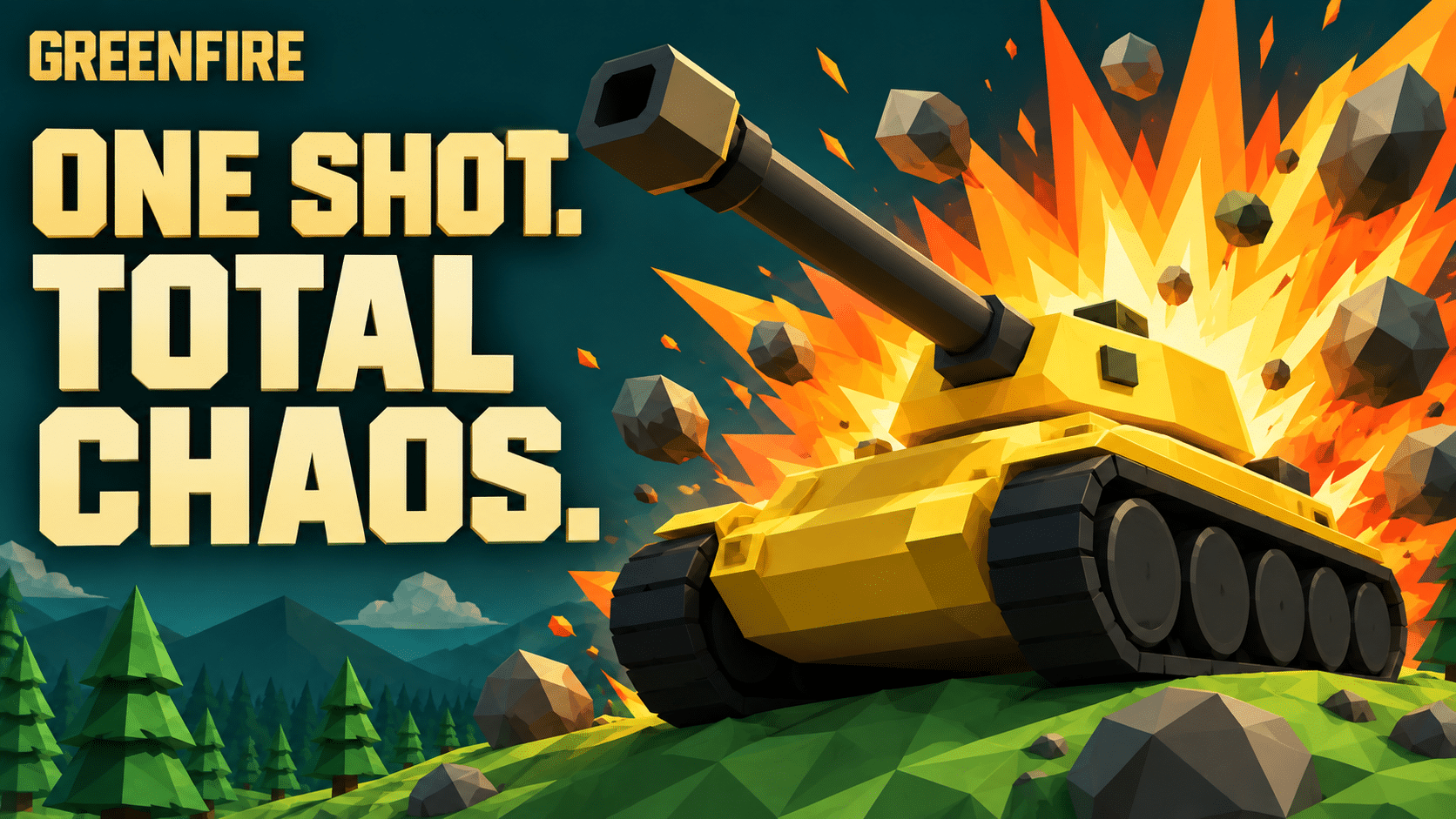
That combination became Greenfire, a turn-based 3D artillery game with destructible terrain, increasingly unreasonable weapons, and chain reactions that can make a successful shot a very bad idea.
Greenfire is a personal hobby project that I develop outside my normal day job and work hours.
I started because I wanted to play this game. As AI tools became more accessible, the project also gave me a practical reason to learn them. There is something motivating about having a specific idea you care enough about to keep improving after the first version works.
The game I wanted to play
Greenfire is an original tribute to Kenneth Morse’s Tank Wars, not an official remake or an affiliated sequel. I wanted to carry forward the pleasure of lining up a shot, choosing a weapon, and waiting to see what happens when it lands.
The basic idea is easy to understand. Tanks take turns firing across a battlefield. You adjust your aim and power, account for the conditions, and try to survive. Between rounds, you buy weapons and defenses. The terrain changes as the battle unfolds, so the ground beneath a tank can matter as much as the tank itself.
The part I especially enjoy is the domino effect. A shot destroys one tank. Its explosion catches another. The ground disappears beneath a third. Then the consequences work their way back toward the person who fired the first shot. Being technically successful and being pleased with the outcome are sometimes very different things.
A bigger bomb is only one answer
Of course, I included big bombs. One is called the Ridiculously Large Bomb. Another is called The Reset Button. Subtlety has its place, but it does not need the entire weapons menu.
Some of the more interesting choices do something else. Dig Your Own Grave removes the dirt beneath an opponent and lets falling do the damage. The Shockwave Launcher sends a tank flying. The Silent Precision Dart rewards a direct hit against an unprotected tank with a kill that does not trigger a death explosion. When you are standing too close to your target, that last detail becomes important.
Those weapons give players different problems to solve. Do you need more damage, a better angle, or a way to avoid being caught in your own chain reaction? I want the answer to depend on the situation, rather than always being “buy the largest explosive you can afford.”
I also added a shooting range with unlimited weapons and targets that do not shoot back. It gives players somewhere to experiment before discovering the consequences in a match. You can see examples in the Greenfire weapons video collection.
Learning AI by giving it a real problem
I have used AI extensively to help develop Greenfire, including working through code, troubleshooting, and preparing material to share the game. My role has involved deciding what I want the experience to be, playing it, noticing what feels wrong, and asking for specific changes. That process has taught me much more than a demonstration in which everything works on the first attempt.
The camera is a good example. Early versions could zoom in so closely that an explosion filled the screen while the rest of the chain reaction happened somewhere else. Pulling back solved that problem, but going too far made the tanks and their surroundings difficult to see. Abrupt turns and cuts created another problem: a camera could technically follow the action and still be unpleasant to watch.
It took several rounds of playing and adjustment to get to a view I liked: enough distance to understand the battlefield, enough closeness to enjoy the impact, and smoother movement between the two. I also caught an edge case where firing after manually zooming in on an enemy left the camera stuck too close to the target.
That was a useful lesson in being specific. “Make the camera better” leaves a lot unanswered. Describing where I was looking, what I clicked, what happened next, and what I missed gave us a problem we could actually work on.
Browser testing brought its own surprises. Something that felt smooth in one browser could pause in another. Recording gameplay introduced a separate set of audio problems. Each issue required separating what I could observe from what I merely suspected. AI made it easier to investigate and try changes, but I still had to play the result and decide whether the change helped.
What comes next
The current browser version includes configurable battles against computer opponents, local hot-seat play, a 20-round single-player campaign, and the shooting range. The Steam store page is live as Coming Soon while I continue preparing and testing the Windows version. Online multiplayer is a future goal; it is not available in the current game.
I would love to see Greenfire become a game that people return to, introduce to friends, and feel was worth their time and money. Getting there means paying attention to the less spectacular details as well as the explosions: clear controls, fair difficulty, reliable performance, and feedback from people who did not build it.
For now, I have taken a game I remembered fondly and used that enthusiasm to build something I can play and share. I am still learning, and I have plenty left to improve. That is a large part of why I want to keep working on it.
If it looks like your kind of game, try Greenfire free in your desktop browser. You can also wishlist Greenfire on Steam or watch more gameplay on YouTube.
And if you try it, I would like to know: which weapon made you laugh, and what made you want another round?